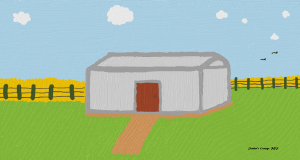
 Settler’s Hut
This is a painting of a Settler’s Hut based on the one that was used as a grain storage shed on my father’s farm. The property was allocated as a Crown Grant circa 1895. The successful applicant moved, from the Guildford farming colony via the newly completed railway being built to connect Perth with the Kalgoorlie gold-fields. Leaving the train at Waeel Siding, he and his family set up home in a tent on a parcel of land which they hoped would become a well-established dairy farm. The land was cleared using hand tools such as saws, axes, mattocks, and crowbars.
None of the timber was wasted, Logs became uprights and beams for buildings which were roofed using leafy branches. Smaller hardwood trees were cut as fence posts and used to construct yards for livestock. Later on, fencing wire and corrugated iron became available to use in the construction of fences and buildings. This Settler’s Hut was built with Salmon Gum uprights which were framed with Gimlet rafters and purlins. The side rails were Gimlet as well. The frame was then clad with galvanised corrugated iron complete with guttering to run rainwater into storage tanks. The building survived for ninety years.
Because such buildings were designed to eventually become grain sheds, there were no windows only a wide sturdy door. The inside was partitioned using hessian strips which hung from wires stretched between the uprights. The floor was compacted clay or anthill where available. On rare occasions, floors were built of timber planks. Money for living expenses and improvements was earned by family members who worked on the goldfields railway, water pipeline, or as miners. My maternal grandfather was employed in the water pumping stations along the Goldfields Pipe-line.
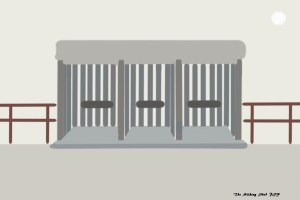 Milking Shed
This milking shed was constructed of bush timber and reject Jarrah rail sleepers. Thatched with straw to keep out the weather with the feeders made from pieces of a hollow log. The floor consists of large flat pieces of granite. The shed has three stalls so the three cows can be milked at a time. The original owners milked up to 12 cows morning and evening. The milk was placed in cans provided by the purchaser, cooled by placing in water, and transported, by horse and cart to the nearest railway siding to be placed on the night train. The fresh milk was available to the consumer within 24 hours of milking.
 Forties Child